Hawthorn Resources traces gold over 1.2 km at Pinjin East; best aircore hole is 8 m at 1.77 g/t
The 19-hole program near the Anglo Saxon pit in WA returned modest grades from 4 m composite samples. RC drilling is next; no resource or target exists.
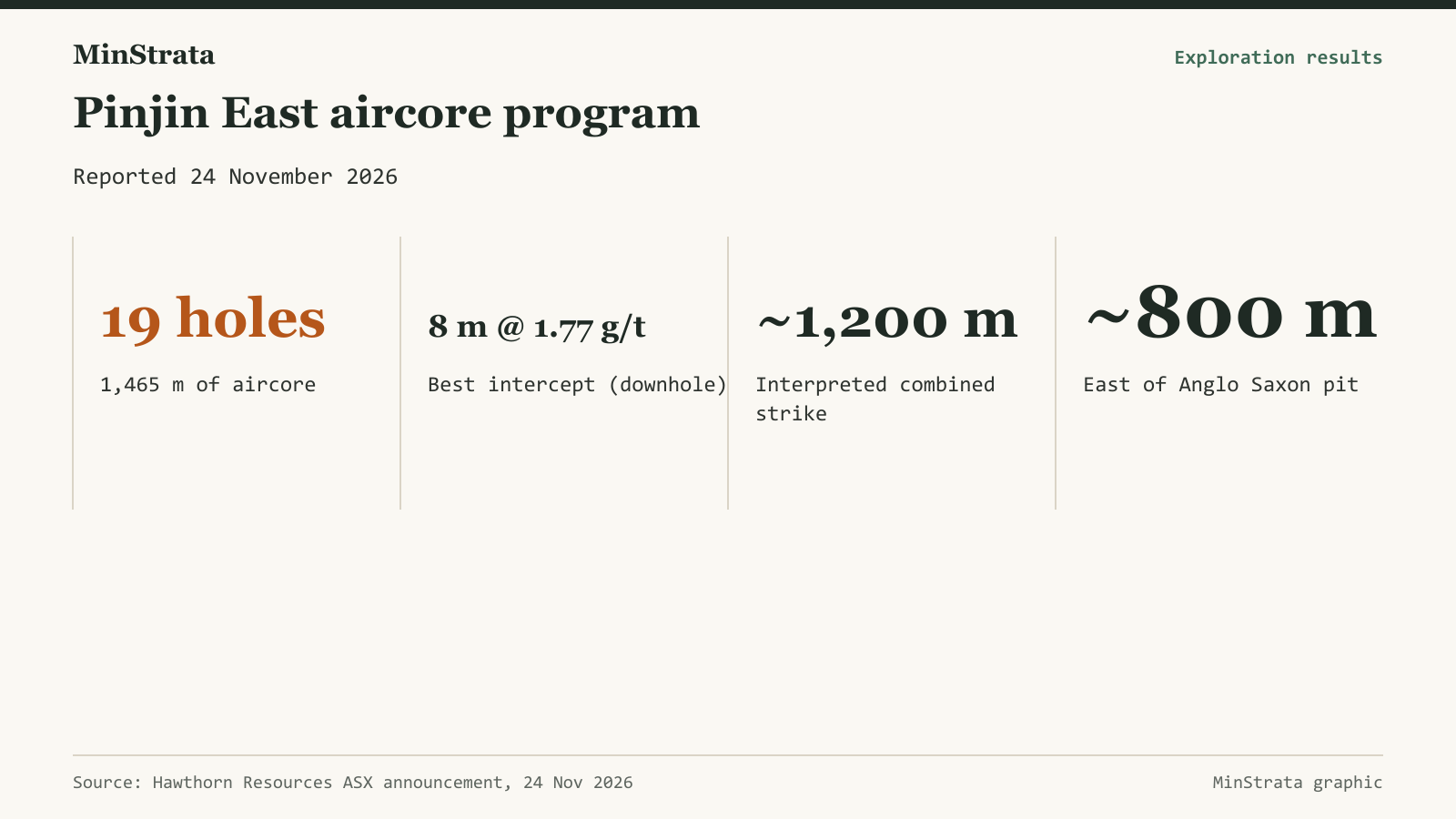
Hawthorn Resources (ASX: HAW) says aircore drilling at its Pinjin East target in Western Australia's Eastern Goldfields has confirmed gold in bedrock along two corridors with a combined interpreted strike of about 1.2 km. The company released the results to the ASX on 24 November 2026.[1]
The company itself describes the grades and widths as modest. Its case rests on the length of the trend and on its position about 800 m east of the Anglo Saxon pit, which the company is looking at for a possible development.[1]
The reported intercepts
| Hole | From-to (m) | Length (m) | Au (g/t) | Gram-metres |
|---|---|---|---|---|
| 26PAC004 | 48-56 | 8 | 1.77 | 14.16 |
| incl. | 52-56 | 4 | 3.16 | 12.64 |
| 26PAC009 | 32-44 | 12 | 1.08 | 12.96 |
| incl. | 32-36 | 4 | 2.33 | 9.32 |
| 26PAC009 | 16-20 | 4 | 1.47 | 5.88 |
| 26PAC011 | 40-80 | 40 | 0.40 | 16.00 |
| 26PAC016 | 60-68 | 8 | 0.87 | 6.96 |
| incl. | 60-64 | 4 | 1.42 | 5.68 |
| 26PAC010 | 72-80 | 8 | 0.45 | 3.60 |
Intercepts combine contiguous 4 m composite samples (scoop sampled) as length-weighted averages; 'incl.' rows overlap their parent interval. All lengths are downhole and true widths are not established. 26PAC010 did not reach the main target; 26PAC011 ended in mineralisation (76-80 m at 0.33 g/t). Fire assay (50 g). Source: Hawthorn Resources ASX announcement, 24 November 2026, Table 1 and JORC Table 1.
What 4 m composites can and cannot tell you
Aircore is a cheap, fast way to drill through weathered rock and test soil anomalies, and composite sampling mixes 4 m of drill chips into one sample. That suits a first pass but blurs where the gold actually sits inside each 4 m.[1]
Hawthorn's own worked example shows the effect: 26PAC004's 8 m at 1.77 g/t is two composites, 4 m at 0.38 g/t and 4 m at 3.16 g/t. The composite piles have been resampled at 1 m intervals, and those results are pending.[1]
The 40 m at 0.40 g/t in 26PAC011 is a downhole length, and the company states it is not a demonstrated 40 m true thickness.[1]
| Lode | Strike | Status |
|---|---|---|
| East Lode 1 | 600 m+ | Open north and south |
| West Lode 1 | 300 m+ | Within E31/1050; open south |
| West Lode 2 | 300 m+ | Within E31/1050; open south |
Strike lengths are the company's interpretation from aircore, historical RAB and RC holes and gold-in-soil trends. Historical hole 22RC012 lies on third-party ground and is excluded. Source: Hawthorn Resources ASX announcement, 24 November 2026, Table 3.
Historical holes help join the trend. A Gutnick Resources RAB hole more than 30 years ago returned 9 m at 0.90 g/t from 96 m, which Hawthorn now places on a southern extension of the East Lode.[1]
“Any additional gold resources at Pinjin East will provide satellite resources within easy trucking distance of a development scenario for Anglo Saxon”
Thornton also called the results a new discovery. No Exploration Target or Mineral Resource has been reported for Pinjin East, and the company says further drilling is needed to show geological and grade continuity.[1]
Reporting basis
The exploration results are reported under the JORC Code (2012). The Competent Person is Joseph Clarry, a Member of the Australian Institute of Geoscientists, engaged by Hawthorn as a consultant. The tenement, E31/1050, is held 100% by Hawthorn and forms part of its Pinjin Gold Project.[1]
What comes next
Hawthorn plans infill and extension RC drilling to define lode geometry, grade continuity and widths, focusing on the contact between basalt and a sulphidic shale where the better grades occur. It says that work is meant to support a JORC Exploration Target and a first look at mining potential.[1]