BPM Minerals reports 9 m at 5.05 g/t gold in early Clyde holes at its Forelands project
The best grades sit in weathered rock above 60 m; the first fresh-rock hits run 1.5 to 1.6 g/t. There is no resource, and 21 Clyde holes await assays.
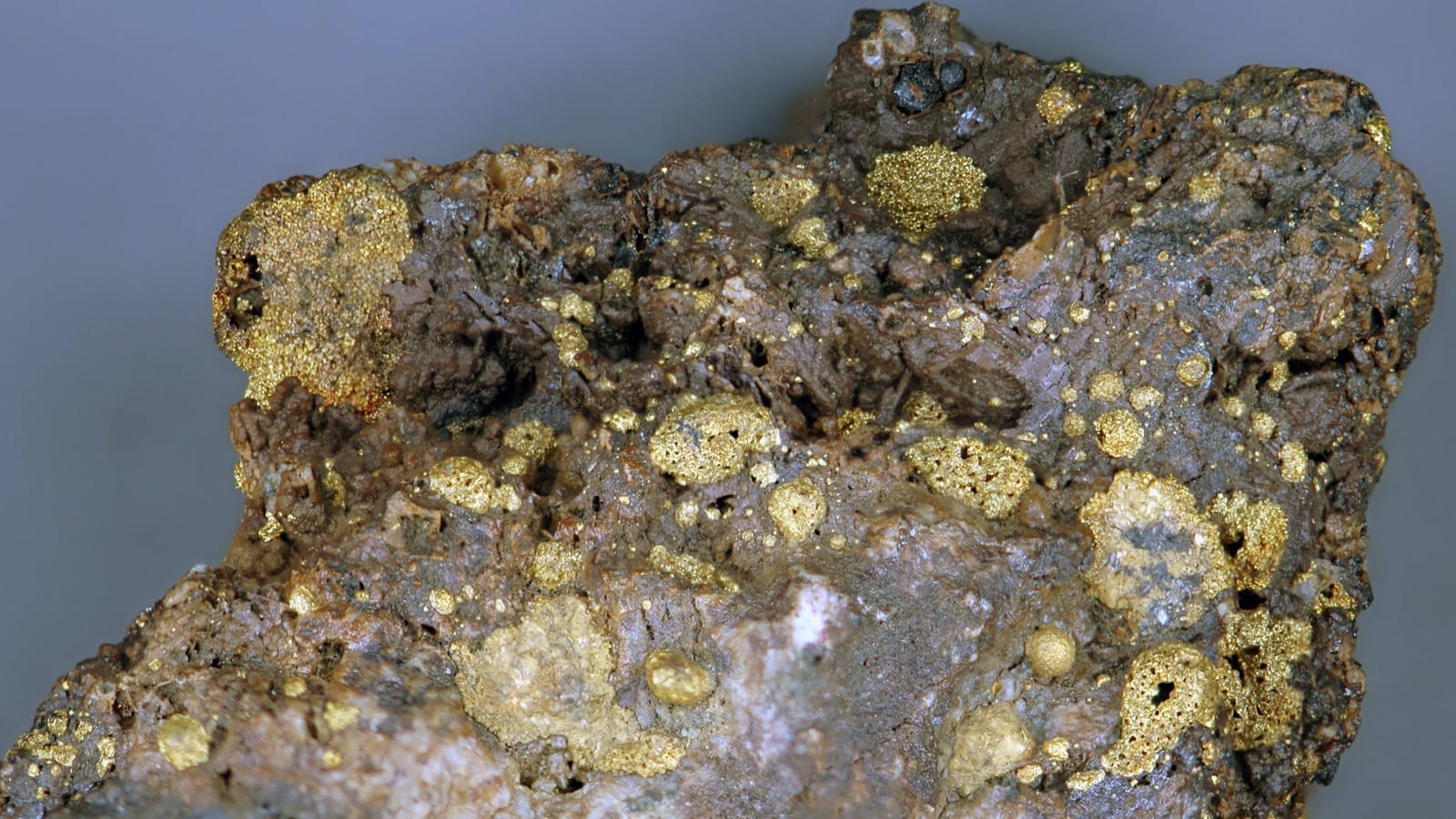
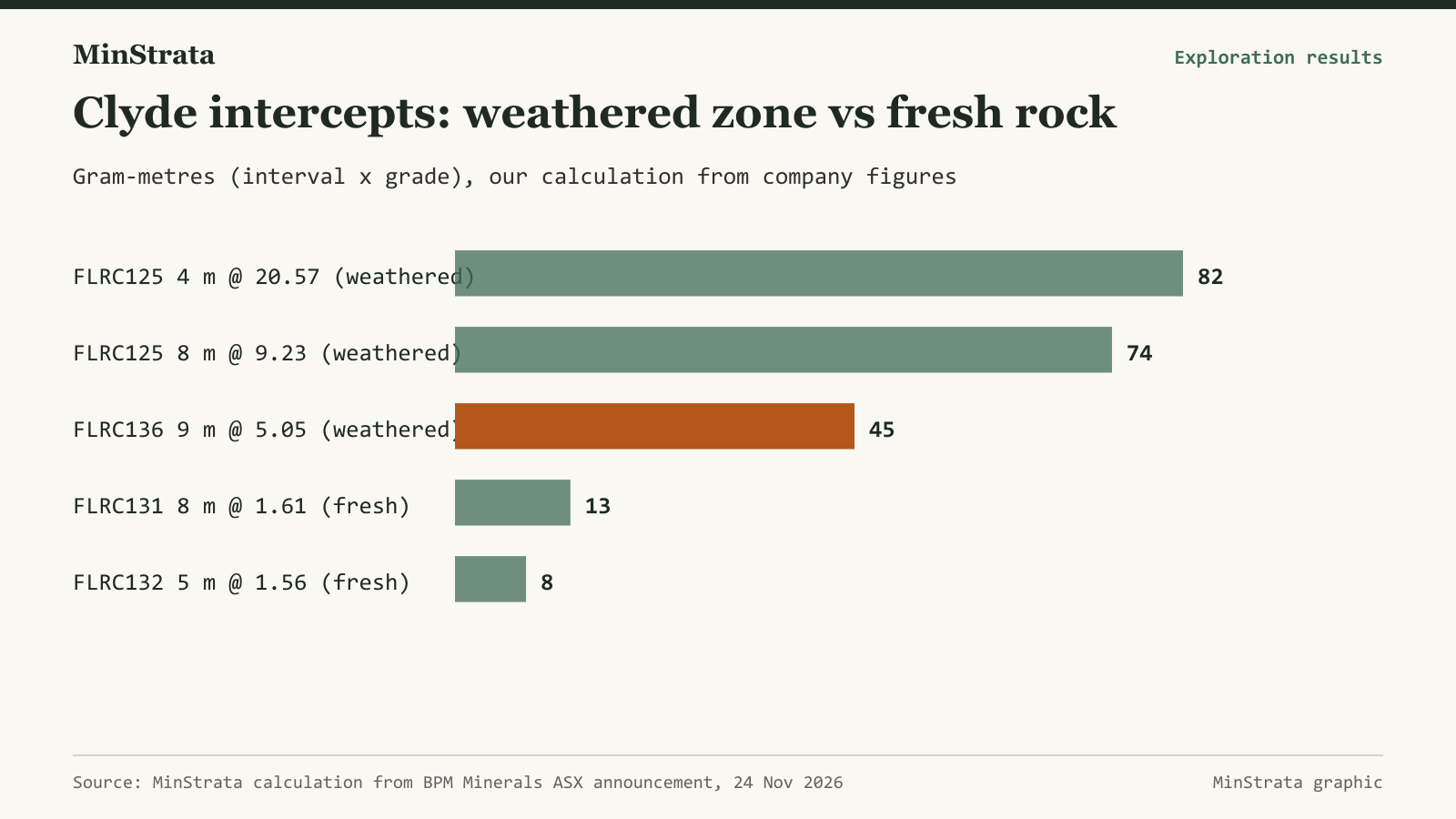
BPM Minerals (ASX: BPM) has reported a second batch of reverse circulation (RC) assays from the Clyde prospect at its Forelands Gold Project, about 170 km east of Kalgoorlie in Western Australia. The best new result is 9 m at 5.05 g/t gold from 44 m in hole FLRC136, released to the ASX on 24 November 2026.[1]
These are among the first holes ever drilled into Clyde. They follow hole FLRC125, reported earlier, which returned 4 m at 20.57 g/t from 39 m and 8 m at 9.23 g/t from 71 m, each including a single metre above 60 g/t.[1]
The reported intercepts
| Hole | From (m) | Interval (m) | Au (g/t) | Rock |
|---|---|---|---|---|
| FLRC136 | 44 | 9 | 5.05 | Weathered (saprolitic clay) |
| incl. | 46 | 2 | 17.07 | |
| FLRC131 | 127 | 8 | 1.61 | Fresh amphibolite |
| FLRC132 | 124 | 5 | 1.56 | Fresh |
| FLRC130 | 76 | 5 | 0.93 | |
| FLRC133 | 146 | 3 | 1.01 | |
| FLRC125 (earlier) | 39 | 4 | 20.57 | Weathered |
| incl. | 40 | 1 | 73.33 | |
| FLRC125 (earlier) | 71 | 8 | 9.23 | Weathered |
| incl. | 72 | 1 | 64.71 |
Significant results above 0.3 g/t Au, from one-metre samples taken with a cone splitter at the rig and assayed by Intertek Genalysis. The company says intercepts are likely to be approximately true width because mineralisation appears tied to shallow-dipping thrusts, but says the orientation is still being interpreted. FLRC124 and FLRC135 returned no significant results. Source: BPM Minerals ASX announcement, 24 November 2026, highlights and Tables 1-2.
Weathered-zone grades and fresh-rock grades are different stories
Clyde sits under a buried river channel 15 to 30 m thick, and the rock beneath is oxidised to about 60 m. BPM says its strongest intercepts, including FLRC136 and FLRC125, likely represent supergene enrichment: gold concentrated by weathering near the surface.[1]
Supergene zones can be rich but are usually limited in depth, so the fresh rock below matters for any larger system. There, in sheared amphibolite dipping about 30 degrees to the south-east, the first results are 8 m at 1.61 g/t in FLRC131 and 5 m at 1.56 g/t in FLRC132.[1]
The high grades are also concentrated. On our calculation, the 2 m at 17.07 g/t holds about 75% of the gram-metres in FLRC136's 9 m interval, and the single metres at 73.33 and 64.71 g/t hold close to 90% of FLRC125's two intervals.[1]
BPM says mineralisation now extends over more than 100 m of strike and more than 200 m down dip, open in both directions, beneath a soil anomaly more than 800 m long. Those extents describe drilling coverage, not a defined body of ore.[1]
“We're still at a very early stage; however, we do know the footprint of Bonnie & Clyde indicates we could be on top of a large gold system.”
Judd went on to describe the potential for a multi-million-ounce discovery. That is the company's ambition. No Exploration Target or Mineral Resource has been reported for the prospect.[1]
Bonnie 2: broad but low grade
The first four holes at the nearby Bonnie 2 prospect returned wide, low-grade intervals, the best being 16 m at 0.62 g/t from 80 m in FLRC129. BPM says the shear zone there is about 40 m thick, mineralised throughout and open at depth and along strike.[1]
Reporting basis
The exploration results are reported under the JORC Code (2012). The Competent Person is Oliver Judd, a Member of the AusIMM and an employee of the company, as the announcement states.[1]
What comes next
BPM expects a diamond rig in early December to drill tails on several RC holes before the Christmas break, and an induced polarisation survey to start soon. It says assays will flow through the rest of the December quarter and the March quarter of 2027.[1]
The company reported A$5.3 million of cash at the end of September and has since raised A$3.3 million from an option exercise. It has also exercised an option over tenement E28/3513, which covers the Sidecar prospect to the north.[1]
Questions readers ask
- Are these intercepts true widths?
- BPM says they are likely approximately true width, because the mineralised shears dip shallowly, but it is still interpreting the orientation.[1]
- Does Clyde have a gold resource?
- No. These are some of the first holes into the prospect. No Exploration Target or Mineral Resource has been reported.[1]