FireFly Metals reports 26.7 m at 2.31% copper from 9 m (downhole) at new Nash prospect in Canada
First drilling at Nash, under 10 km from the Ming mine in Newfoundland, returned shallow copper outside the Green Bay resource. Width and extent are unresolved.
FireFly Metals (ASX: FFM) has reported 26.7 metres at 2.31% copper from 9.0 m downhole in the first diamond drilling at Nash, a new prospect less than 10 km from its Ming copper-gold mine in Newfoundland and Labrador, Canada. The Perth-based company, also listed on the Toronto Stock Exchange, lodged the results with the ASX at 8:27am AEDT on 24 November 2026.[1]
The result is an exploration result, not an estimate of tonnes or grade. Nash sits outside the Green Bay Mineral Resource, and the company describes it as a copper-rich volcanogenic massive sulphide (VMS) system: a deposit style formed where metal-bearing hot fluids vented on an ancient sea floor.[1]
The reported intercepts
| Hole | Prospect | From (m) | To (m) | Interval (m) | Cu (%) | Au (g/t) | CuEq (%) |
|---|---|---|---|---|---|---|---|
| FFR26-024 | Nash | 9.00 | 35.70 | 26.70 | 2.31 | 0.03 | 2.38 |
| incl. | Nash | 26.10 | 35.70 | 9.60 | 4.64 | 0.05 | 4.79 |
| FFR26-036 | Nash | 21.70 | 43.00 | 21.30 | 1.20 | 0.01 | 1.25 |
| incl. | Nash | 24.20 | 27.90 | 3.70 | 2.10 | 0.02 | 2.16 |
| FFR26-006 | Nash | 14.45 | 18.65 | 4.20 | 1.83 | 0.02 | 1.88 |
| FFR26-008 | Nash | 10.00 | 15.45 | 5.45 | 1.40 | 0.02 | 1.45 |
| FFR26-043 | RDI | 15.90 | 27.10 | 11.20 | 1.22 | 0.02 | 1.26 |
| incl. | RDI | 15.90 | 19.85 | 3.95 | 2.32 | 0.05 | 2.40 |
Cut-off 0.5% Cu or 0.5 g/t Au, maximum 6 m internal waste, length-weighted. NQ diamond core, half-core sampled; assays by Eastern Analytical (Springdale, NL) and AGAT Laboratories (Thunder Bay, ON); Au by fire assay. Width status: the company's Appendix C says results are approximate true thickness; its JORC Table 1 says the intersections are downhole and more information is needed to assess true thickness. CuEq uses the company's prices (US$11,000/t Cu, US$3,600/oz Au). Selected rows; the full table lists about 50 holes. Source: FireFly Metals ASX announcement, 24 November 2026, Appendix C.
Earlier wide-spaced holes FFR26-006 and FFR26-008 gave the first primary copper at Nash. A downhole electromagnetic survey from FFR26-006 then picked up a conductor about 17 m off the hole, which FFR26-024 was drilled to test.[1]
After FFR26-024, the company stripped topsoil around the collar and cut rock-saw channels across the exposed bedrock. Trench 26_NS_TR_01 returned 24.0 m at 1.20% Cu, using a 1.0% Cu cut-off and 1 m channel samples; other channels returned 10 m at 2.2% Cu, 5.0 m at 3.5% Cu and 4.0 m at 5.2% Cu.[1]
The company also reported 44 surface rock-chip samples above 1% Cu, the highest at 19.8% Cu. Rock chips are selected samples of outcrop, so they show that copper is present but are not a measure of average grade.[1]
How to read these results
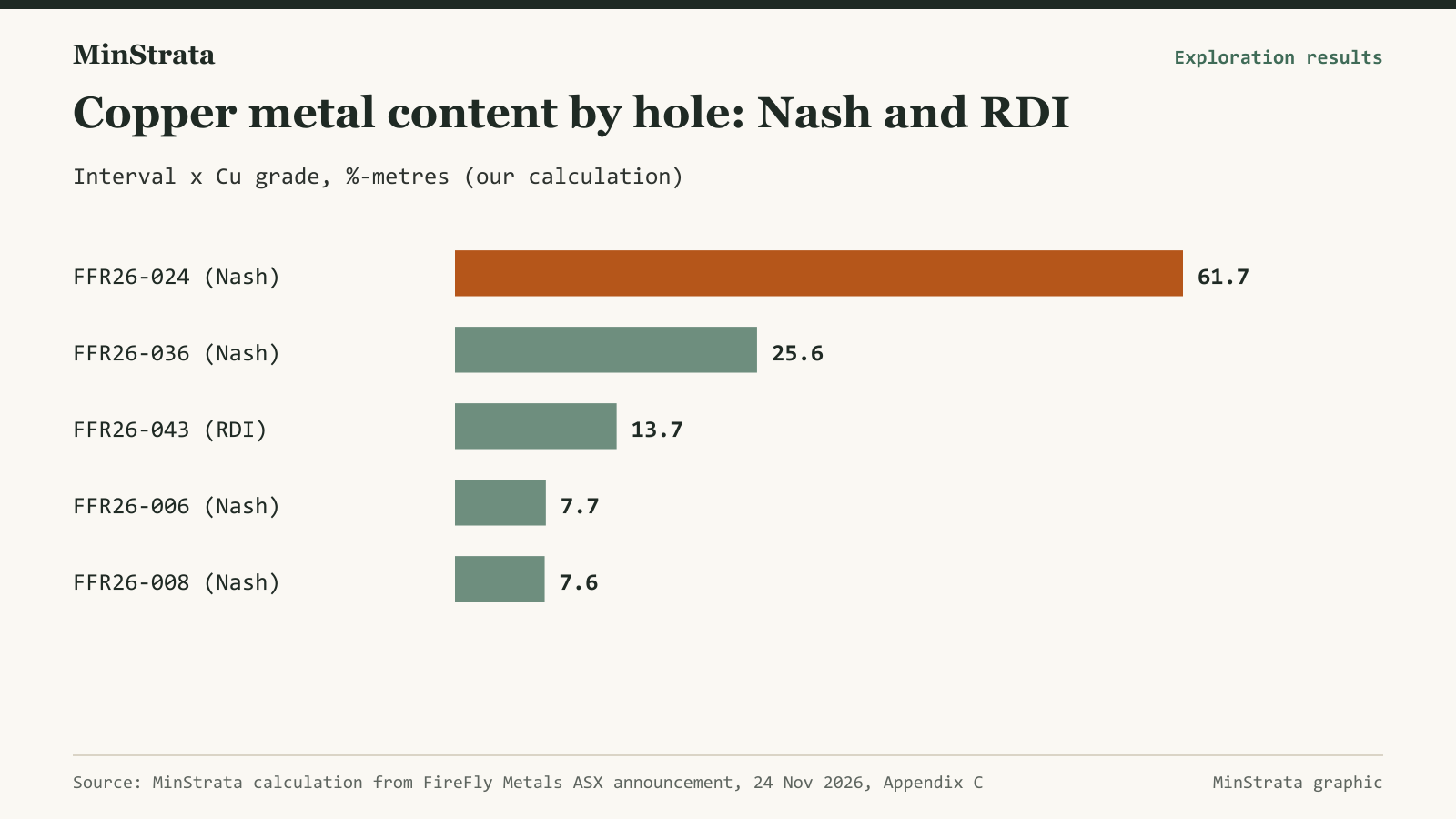
Multiplying interval by grade gives a rough measure of metal in a hole. On our calculation, FFR26-024 carries 61.7 %-metres (26.7 x 2.31), against 25.6 for FFR26-036 and 13.7 for RDI hole FFR26-043. The 9.6 m higher-grade zone alone holds about 44.5 %-metres, or 72% of the hole's total.[1]
From the collar coordinates in the company's table, FFR26-036 was collared about 28 m from FFR26-024 (our calculation). The two holes therefore test a small area. RDI lies about 1.1 km away on the same geophysical trend.[1]
The intercepts were calculated at a 0.5% Cu cut-off, half the 1.0% Cu cut-off used for the Green Bay resource. The two sets of grades are not directly comparable.[1]
The announcement gives two versions of the higher-grade zone in FFR26-024. The key points and Appendix C give 9.6 m at 4.6% Cu, while the caption to Figure 5 gives 5.9 m at 4.9% Cu. We have used the Appendix C figure.[1]
What the results don't show
- Continuity: most of the 3 km-plus airborne electromagnetic conductor around Nash and RDI is undrilled, and the company says mineralisation is open in all directions. Several holes had no significant assays and others are pending.
- True width: the announcement describes the intercepts both as downhole and as approximate true thickness, so the real thickness of the zone is not settled.
- Metallurgy: no test work on Nash material is reported. The 95% copper recovery in the company's copper-equivalent formula is based on historical Ming production.
- Economics: the company says the shallow depth shows potential for open-pit mining, but no study covers Nash. Its link to the historic O'Sullivan copper boulders is described as a belief.
The existing resource, by category
| Category | Tonnes (Mt) | Cu (%) | Au (g/t) | Ag (g/t) | CuEq (%) |
|---|---|---|---|---|---|
| Measured | 3.5 | 1.5 | 0.2 | 1.3 | 1.67 |
| Indicated | 56.7 | 1.9 | 0.5 | 4.4 | 2.48 |
| Measured + Indicated | 60.2 | 1.9 | 0.5 | 4.2 | 2.43 |
| Inferred | 23.5 | 1.9 | 0.6 | 5.2 | 2.51 |
Reported at a 1.0% Cu cut-off under the JORC Code (2012) and NI 43-101. Inferred is shown separately and not added to Measured and Indicated. CuEq at US$10,626/t Cu, US$3,587/oz Au and US$50.22/oz Ag with 95% Cu and 85% Au/Ag recovery. Totals may not add due to rounding. Source: FireFly Metals ASX announcement, 24 November 2026, Appendix A.
Reporting basis
The exploration results are reported under the JORC Code (2012) and Canada's NI 43-101. The Competent Person is Darren Cooke, a member of the Australian Institute of Geoscientists, who the company says is a full-time employee and holds securities in FireFly. Group Chief Geologist Juan Gutierrez also reviewed the announcement.[1]
“We have now made two highly significant discoveries in a month and we have identified numerous similar targets to test using the same exploration approach.”
Parsons said this in the announcement. The other discovery he referred to is Mount Joy, which FireFly reported on 27 October 2026.[1]
Brass Buckle option
FireFly also signed an option to acquire the Brass Buckle property, 16.5 square kilometres of claims next to Nash, from Krinor Resources Inc. and local prospectors. It would pay C$500,000 in stages over three years (C$100,000 paid on signing), spend at least C$500,000, and grant the vendors a 2% net smelter return royalty, half of which it could buy back for C$1.5 million.[1]
What comes next
One surface rig is drilling at Nash, with results expected over the coming months. Three regional rigs are operating, and assays are pending from Mount Joy and other targets.[1]
The company plans a Green Bay resource update in March 2027, a feasibility study on a 1.8 Mtpa restart at Ming in the first quarter of 2027, and a maiden resource at the Main Mine prospect in the same quarter. It says all timeframes are indicative. FireFly reported about A$349.7 million in cash and liquid investments (unaudited) at 30 September 2026.[1]
Questions readers ask
- Is Nash part of FireFly's Mineral Resource?
- No. Nash is reported as exploration results only. The Green Bay resource covers the Ming and Little Deer deposits.[1]
- What does 'downhole' mean in a drill result?
- It is the length measured along the drill hole. If the hole crosses the mineralised zone at an angle, the true thickness is less than the downhole length.[1]