Kaoko Metals hits 54 m at 1.03% copper in first Donkey Hill hole; one rich sample holds nearly a fifth
DDDH001 ended in mineralisation in a cavity; a steeper hole returned 47 m at 1.18% copper. True widths are unknown and there is no resource.
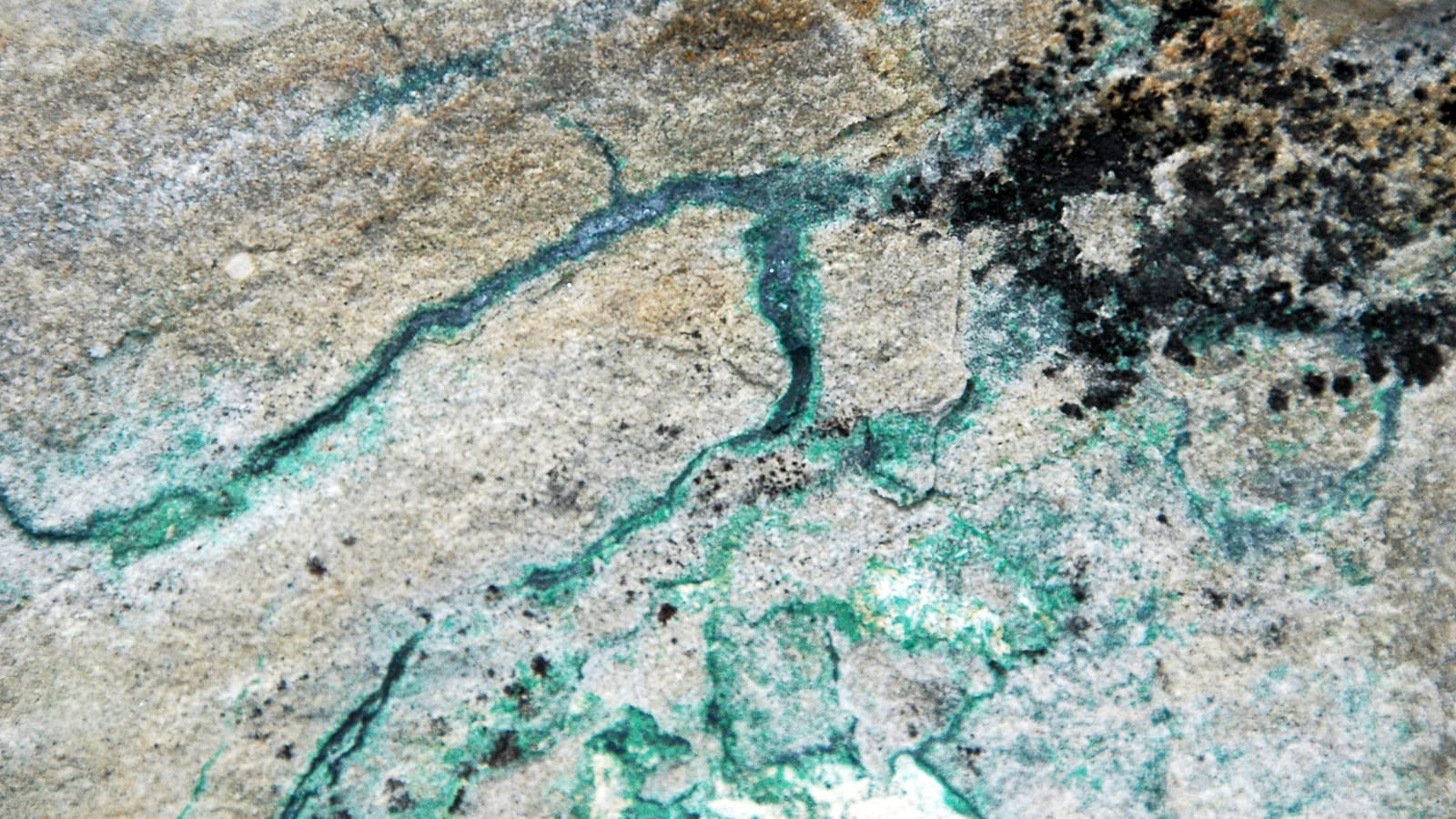
Kaoko Metals (ASX: KAO) has reported assays from the first two holes ever drilled at the Donkey Hill prospect, part of its Chalkos copper-silver project in north-western Namibia. The announcement, lodged with the ASX on 25 November 2026, also covers four more holes at the Otniel prospect, about 2.2 km to the south-south-east, where drilling has been under way since earlier this year.[1]
Kaoko interprets the two prospects as sitting in the same sedimentary sequence, the Ombombo Subgroup, and describes the mineralisation as a shallow, fault-influenced, sediment-hosted copper-silver system that may be of red-bed style. Copper at Donkey Hill occurs mainly as malachite and chalcocite. Mapped surface copper at Donkey Hill and Donkey Hill East covers more than 1.5 km of cumulative strike, most of it not yet drilled.[1]
“DDDH001 ended in mineralisation after encountering a cavity, so the base of the system is not yet defined, and DDDH002 confirms the zone continues down-dip and remains open.”
The reported intercepts
| Hole | Prospect | From (m) | Length (m) | Cu (%) | Ag (g/t) |
|---|---|---|---|---|---|
| DDDH001 | Donkey Hill | 8.95 | 54.05 | 1.03 | 29.2 |
| incl. | 8.95 | 4.55 | 3.35 | 90 | |
| incl. | 12.20 | 0.75 | 13.35 | 391 | |
| and | 47.0 | 5.0 | 3.54 | 86 | |
| DDDH002 | Donkey Hill | 51.55 | 47.45 | 1.18 | 36.2 |
| incl. | 65.0 | 34.0 | 1.30 | 42.9 | |
| incl. | 76.0 | 11.0 | 2.01 | 63.7 | |
| DDDH002 | Donkey Hill | 132.0 | 9.0 | 2.19 | 15.0 |
| DDOT004 | Otniel | 99.0 | 19.82 | 1.05 | 14.4 |
| DDOT006 | Otniel | 73.0 | 27.5 | 0.71 | 11.9 |
| DDOT003 | Otniel | 77.0 | 17.0 | 0.76 | 11.1 |
Downhole lengths; true widths are not yet known. Length-weighted averages of half-core samples of nominal 1 m length, selected at a nominal 0.2% Cu cut-off with no top cut, including samples below the cut-off as internal dilution. In the DDDH002 interval from 132 m, a 0.4 m sample at 34.4% Cu contributes about 70% of the copper, as the company states. No metal equivalents reported. Source: Kaoko Metals ASX announcement, 25 November 2026.
How much rests on a few samples
Multiplying length by grade gives the copper content of an interval in percent-metres. The 54.05 m interval in DDDH001 comes to about 55.7 percent-metres. The single 0.75 m chalcocite-rich sample at 13.35% copper, which Kaoko calls the highest-grade drill sample at Chalkos so far, accounts for about 10.0 of them, or roughly 18%, from about 1.4% of the length. These are our calculations from the rounded figures in the announcement.[1]
The hole is also not uniformly mineralised. Kaoko reports it as an upper zone of 8.05 m at 2.01% copper and a lower zone of 42.86 m at 0.93% copper, separated by about 6 m of dolomite carrying 0.03% to 0.18% copper, and the 56.91 m sampled length includes 18.9 m below the 0.2% cut-off. DDDH002 is more even: its 11 m at 2.01% copper accounts for about 39% of the copper in the 47.45 m interval, and the 34 m at 1.30% for about 79%, by our calculation.[1]
Because DDDH001 was drilled at 45 degrees and DDDH002 at 65 degrees from the same pad, the two holes test the same zone at different depths rather than along strike. A step-out hole about 90 m to the north-north-east, DDDH003, is being drilled after two earlier attempts from that pad were abandoned when equipment was lost.[1]
Otniel: every hole mineralised, at lower grades
At Otniel all four new holes hit copper and silver, so every hole drilled there so far has intersected mineralisation, the company says. Intercepts now come from three drill pads spread over about 185 m. The new results are thinner and lower grade than the discovery holes reported on 12 October 2026, 37.1 m at 1.23% copper and 48 m at 1.02%. Kaoko says DDOT003 largely stayed in the footwall, that DDOT006 may have passed beneath the higher-grade core, and that DDOT005 may lie across a fault that cuts off or offsets the mineralisation.[1]
Reporting basis
The results are reported under the JORC Code (2012). Samples were analysed by ALS using a four-acid digest with an ICP-AES finish (method ME-ICP61a), with over-limit copper and silver re-assayed by ore-grade methods; quality control included standards, blanks and duplicates. The Competent Person for the exploration results is Jason Froud, a Member of the Australian Institute of Geoscientists, who is a consultant to Kaoko Metals and is employed full time by Arc Geoscience Pty Ltd, as the announcement states. MinStrata has not independently verified the results.[1]
What comes next
Three diamond rigs are now working at Chalkos, including a third that started hole DDDH004 at Donkey Hill East. Drone magnetic and ground induced-polarisation surveys started in the week of 23 November, with downhole geophysical logging in November and December. Kaoko expects assays for DDDH003, DDDH003A, DDOT007 and DDOT008 in late December 2026 or early 2027. It reported about $22 million in cash at 30 September 2026.[1]
Questions readers ask
- Is the copper zone at Donkey Hill 54 m thick?
- Not necessarily. 54 m is the length of core in the hole, and Kaoko says true widths are not yet known. The hole's full 56.91 m sampled length also includes 18.9 m of samples below the 0.2% copper cut-off.[1]
- Does Kaoko have a copper resource at Chalkos?
- No. The Donkey Hill and Otniel figures are exploration results from the company's first drilling programme; no Mineral Resource has been reported for the project.[1]