Caprice Resources reports 5 m at 11.61 g/t gold (downhole) 400 m south of its Island resource
RC results from Golconda and Vadrians in WA's Murchison sit outside the maiden resource. Most of the gold is in 2 to 4 m zones, and 24 holes await assays.
Caprice Resources (ASX: CRS) has reported reverse circulation (RC) drill results from its Island Gold Project in Western Australia's Murchison region that extend gold intersections about 400 m south of its maiden Mineral Resource. The company lodged the results with the ASX on 24 November 2026.[1]
The best result, 5 m at 11.61 g/t gold from 72 m downhole in hole 26IGRC131, came from the Golconda banded iron formation (BIF), a layered iron-rich rock that hosts much of the gold on the island. The intercept is shallow by Murchison standards.[1]
The reported intercepts
| Hole | Target | From (m) | Interval (m) | Au (g/t) |
|---|---|---|---|---|
| 26IGRC131 | Golconda | 72 | 5 | 11.61 |
| incl. | 72 | 3 | 18.07 | |
| 26IGRC129 | Golconda | 150 | 7 | 3.70 |
| incl. | 151 | 2 | 12.28 | |
| 26IGRC130 | Golconda | 196 | 6 | 2.94 |
| incl. | 198 | 4 | 4.22 | |
| 26IGRC131 | Vadrians | 242 | 14 | 1.80 |
| incl. | 248 | 3 | 4.33 |
Intervals at a 0.3 g/t Au cut-off with up to 3 m of internal waste; intervals above 1.0 g/t reported as significant. All lengths are downhole; true width is not known, and the company estimates it at 60-70% of the intercept. RC samples split by cyclone and cone splitter. Source: Caprice Resources ASX announcement, 24 November 2026, highlights and Table 1.
Caprice says the Golconda results, with an earlier 3 m at 8.73 g/t from 192 m in 26IGRC083, point to a shallow south-plunging mineralised trend more than 150 m long. It also says the continuity and grade between the new holes have not been tested.[1]
The 6 m at 2.94 g/t in 26IGRC130 may sit on a second shoot within the Golconda BIF. The company says more drilling is needed to establish its geometry.[1]
Where the gold sits in each interval
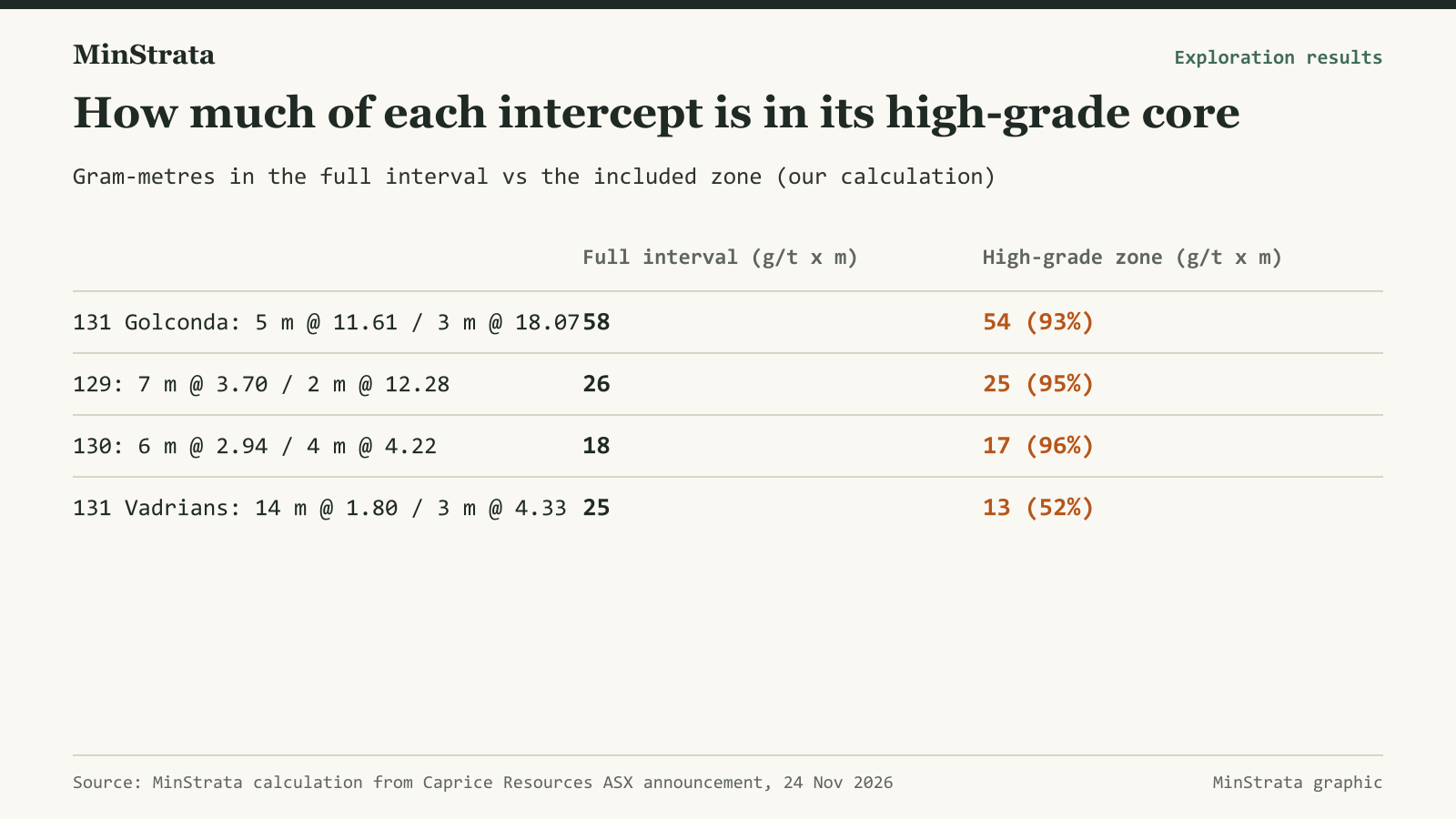
Gram-metres, the interval length multiplied by its grade, give a rough measure of the gold in an intercept. On that basis, the 3 m at 18.07 g/t holds about 93% of the gold in 26IGRC131's 5 m Golconda interval. That is our calculation from the company's figures.[1]
The pattern repeats: the 2 m at 12.28 g/t accounts for about 95% of 26IGRC129's interval, and the 4 m at 4.22 g/t about 96% of 26IGRC130's. The deeper Vadrians intercept is more even, with its 3 m core carrying about 52%.[1]
Narrow, high-grade zones are typical of BIF-hosted gold, but they make interval averages sensitive to a few samples. Applying the company's 60% to 70% estimate, the 5 m Golconda intercept would be about 3 to 3.5 m thick.[1]
What the results don't show
- Continuity: the holes are single pierce points along a trend the company is still interpreting.
- A resource change: these are exploration results outside the maiden Mineral Resource, which the company says will be updated as results arrive.
- Results from the wider programme: assays for 4,435 m from 24 RC holes and all 162 aircore holes are pending.
- Weaker targets: North Vadrians and The Gap returned only weak gold, which Caprice attributes to drilling away from favourable structures.
“These results point to another mineralised shoot of developing scale south of the Central Island structural break”
Reporting basis
The exploration results are reported under the JORC Code (2012). The Competent Person is Luke Cox, a Fellow of the Australasian Institute of Mining and Metallurgy, who is also the company's Managing Director and a full-time employee, as the announcement states.[1]
What comes next
Caprice has drilled 35,624 m of a planned 50,000 m programme. It has finished RC holes across the 400 m gap between Golconda and 26IGRC083, started follow-up holes around the Vadrians step-out, and drilled first holes at two new targets, First Light and Teamwork. All those assays are pending and will be reported in batches.[1]
Questions readers ask
- Is 5 m at 11.61 g/t the true thickness of the gold zone?
- No. It is a downhole length. The company estimates true widths at 60% to 70% of the intercepts, so the zone is likely thinner.[1]
- Do these results add to the Island resource?
- Not yet. They are exploration results outside the current Mineral Resource, which Caprice says it will update as results become available.[1]