True North Copper declares 3.5 Mt Probable reserve as Cloncurry PFS models A$123M post-tax NPV
The four-year toll-treatment plan in north-west Queensland needs about A$53M from late 2027 and depends on access to a third-party concentrator.
True North Copper Limited (ASX: TNC) has declared a maiden Ore Reserve for its Cloncurry Copper Project in north-west Queensland, released with a pre-feasibility study (PFS) on 24 November 2026. The Reserve is 3.52 Mt at 0.86% copper and 0.24 g/t gold, all in the Probable category, and contains about 30 kt of copper and 27 koz of gold.[1]
The study plans four years of open-pit mining at Wallace North, about 30 km south-east of Cloncurry, and at the Great Australia complex just south of the town. Most ore would be trucked to a third-party concentrator for toll treatment rather than to a new plant, which is why upfront capital is only A$8M.[1]
A PFS is the first study level at which the JORC Code allows an Ore Reserve to be declared. It is not a final engineering study, and the company puts its cost and financial estimates at about ±25%. True North says it intends to move towards a final investment decision without a separate definitive feasibility study.[1]
What the study outputs depend on
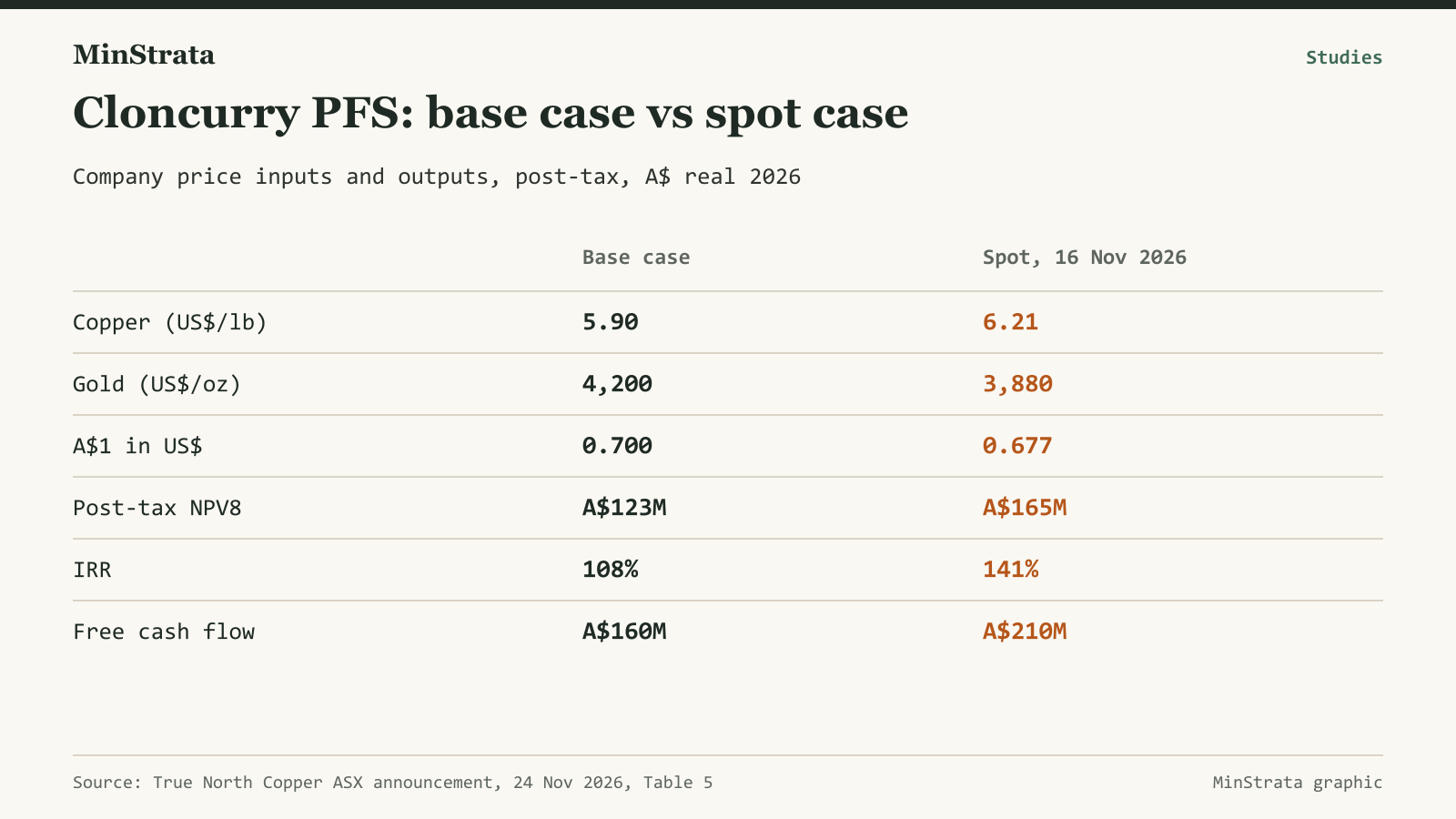
Every economic figure in the study rests on the company's price and currency inputs. Its base case uses consensus forecasts from a survey dated 19 October 2026; the second case uses spot prices on 16 November 2026, when gold was lower and the Australian dollar weaker.[1]
| Measure | Base case | Spot case (16 Nov 2026) | Assumptions and basis |
|---|---|---|---|
| Copper price | US$5.90/lb | US$6.21/lb | Consensus survey 19 Oct 2026 (base) |
| Gold price | US$4,200/oz | US$3,880/oz | As above |
| Exchange rate | A$1 = US$0.700 | A$1 = US$0.677 | As above |
| Post-tax NPV | A$123M | A$165M | 8% discount rate; PFS level, about ±25% |
| IRR | 108% | 141% | No income tax modelled (about A$206M of tax losses) |
| Post-tax free cash flow | A$160M | A$210M | Life of mine |
| EBITDA | A$220M | A$269M | Life of mine |
| Pre-production capital / working capital | A$8M / A$45M | A$8M / A$45M | Toll-treatment case |
| C1 / AISC | A$4.52 / A$5.09 per lb | A$4.48 / A$5.10 per lb | Payable copper; gold credit A$6,000/oz |
| Payback | 10 months | 8 months | Company estimate |
| Inferred share of production target | 10% | 10% | Contained CuEq basis |
Valuation includes 100% of Mongoose-Taipan, part of which sits in a joint venture where True North holds about 36% and Glencore the rest; the company says the non-True North share is about 10.5% of total contained metal and the economics are not adjusted for it. CuEq uses US$10,000/t copper and US$3,500/oz gold at 90% recoveries. Source: True North Copper ASX announcement, 24 November 2026, Tables 1 and 5.
The tax line matters. True North has modelled no corporate income tax because it expects about A$206M in carried-forward losses at 30 June 2026 to absorb the project's taxable income. The post-tax figures are therefore the same as pre-tax cash flows.[1]
Resources and the new Reserve, by JORC category
The Reserve sits inside a much larger Mineral Resource of 20.64 Mt at 0.74% Cu and 0.26 g/t Au, which the company says has grown 62% in contained copper equivalent since December 2025. The categories differ sharply in confidence, so they are shown separately below.[1]
| Estimate and category | Tonnes (Mt) | Cu (%) | Au (g/t) | Contained CuEq (kt) |
|---|---|---|---|---|
| Resource: Measured | 0.42 | 0.48 | 2.12 | 11.0 |
| Resource: Indicated | 12.72 | 0.76 | 0.25 | 128.9 |
| Resource: Inferred | 7.51 | 0.70 | 0.17 | 65.5 |
| Resource total (inclusive of Reserve) | 20.64 | 0.74 | 0.26 | 204 |
| Reserve: Proved | nil | - | - | - |
| Reserve: Probable | 3.52 | 0.86 | 0.24 | 38.6 |
Resource cut-offs vary by deposit (0.3% Cu to 0.6% Cu, 0.4% CuEq at Mongoose-Taipan, 0.4 g/t Au at Wynberg). Reserve cut-offs 0.60-0.65% CuEq for flotation ore; Reserve estimated at US$4.80/lb copper with about 5% dilution and 86% mining recovery. Resources are reported inclusive of the Reserve and must not be added to it. Source: True North Copper ASX announcement, 24 November 2026, Tables 7 and 8.
On our calculation, the Reserve converts about 19% of the resource's contained copper equivalent, and about a third of the resource metal is still Inferred. The company says only about 5 Mt of the roughly 20 Mt resource is in the initial mine plan.[1]
Wallace North carries the highest grade in the Reserve, at 0.70 Mt and 1.96% CuEq. Mongoose-Taipan is the largest part by tonnes, at 1.97 Mt and 0.92% CuEq, but some of it lies on a permit held in the joint venture with Glencore and needs a mining lease that has been applied for but not granted.[1][2]
How much of the plan relies on lower-confidence material
The production target is larger than the Reserve because it also schedules Indicated and Inferred material inside the pit designs. The company's cautionary statement says Inferred Resources carry low geological confidence and there is no certainty they will become Indicated Resources or that the target will be realised.[1]
| Source | Tonnes (kt) | CuEq (%) | CuEq (kt) | Share |
|---|---|---|---|---|
| Probable Ore Reserve | 3,522 | 1.10 | 38.6 | 79% |
| Indicated Resource outside Reserve | 1,205 | 0.45 | 5.4 | 11% |
| Inferred Resource | 616 | 0.79 | 4.9 | 10% |
| Production target total | 5,356 | 0.92 | 49.0 | 100% |
Indicated material outside the Reserve is below the Reserve cut-off but above the marginal cut-off at the US$5.90/lb base-case price. Totals may not sum due to rounding. Source: True North Copper ASX announcement, 24 November 2026, Table 9.
Price and cost sensitivity
The company tested base-case free cash flow against swings of 20% and 40% in each main input. Copper price and grade, and the exchange rate, move the result most; capital cost barely moves it because so little is spent upfront.[1]
Data table
| Item | A$M, life of mine |
|---|---|
| -40% | 45.0 |
| -20% | 53.0 |
| Base | 160.0 |
| +20% | 267.0 |
| +40% | 374.0 |
Source: True North Copper ASX announcement, 24 November 2026, Table 6. The -40% case stays positive at A$45M as reported by the company.
A stronger Australian dollar works against the project. The company's table shows a 20% rise in the exchange rate cutting free cash flow to A$59M, and a 40% rise to A$7M; a 20% fall lifts it to A$313M. A 20% rise in capital cost reduces it only to A$149M.[1]
Funding and processing are the open questions
The company estimates it will need about A$53M from late 2027. It says it has preliminary expressions of interest from potential funders and will prioritise debt, royalties, streaming, joint ventures or a partial or full sale of the project, while not ruling out new equity.[1]
True North also says it may monetise Cloncurry to help fund its Mt Oxide project, which it calls its flagship. Its cautionary statement warns that a joint venture or sale could materially reduce its interest in Cloncurry.[1]
Processing capacity is the second gap. The study's cost assumptions are an average of the two most likely regional host plants, and the company lists securing capacity and terms, including alternatives to Glencore arrangements that expire in late 2027, among its key threats.[1]
“The Cloncurry PFS demonstrates a capital-efficient copper development opportunity with strong financial returns, a short pathway to production and significant value potential for TNC shareholders.”
Next decision gate
Mr Mooney said in the announcement that the company's attention now turns to approvals and commercial arrangements.[1]
“Our focus now is on progressing approvals, refining the development plan and advancing commercial opportunities, including toll processing, partnerships and potential monetisation.”
Extension drilling at Wallace North and Mongoose-Taipan runs to mid-2027, alongside metallurgical testwork on the Wynberg gold-copper deposit. True North targets a final investment decision between Q4 2027 and Q1 2028, subject to approvals, funding and a processing agreement.[1]
Questions readers ask
- Does True North have to build a processing plant at Cloncurry?
- Not in the base case. About 91% of the metal would go through a regional concentrator under a toll agreement, and the rest through the existing Great Australia heap leach, once restarted.[1]
- Why are the post-tax and pre-tax returns the same?
- The company has modelled no income tax because it expects about A$206M of carried-forward tax losses to cover the project's taxable income.[1]