Waratah Minerals reports 10 m at 12.18 g/t gold from 49 m (downhole) at Goldenclad, outside Spur resource
Partial assays from two holes still drilling at Goldenclad, in the East Lachlan region of NSW. True widths are not yet known.
Waratah Minerals (ASX: WTM) has reported 10 metres at 12.18 g/t gold from 49 m downhole in diamond hole GCD002 at Goldenclad, part of its Spur Gold Project in the East Lachlan region of New South Wales. The company lodged the partial results with the ASX at 8:22am AEDT on 24 November 2026.[1]
GCD002 is the first drill test of the Wollard's Line, an outcropping trend of gold lodes identified in 2015. The results are exploration results from outside the current Spur resource. Both holes reported are still drilling, and the assays cover only their upper sections.[1]
The reported intercepts
| Hole | From (m) | To (m) | Interval (m) | Au (g/t) | Cut-off used |
|---|---|---|---|---|---|
| GCD002 | 11.3 | 32.0 | 20.7 | 0.55 | 0.5 g/t |
| GCD002 | 49.0 | 66.0 | 17.0 | 7.35 | 0.1 and 0.5 g/t |
| incl. | 49.0 | 59.0 | 10.0 | 12.18 | 1 g/t |
| GCD002 | 98.0 | 116.0 | 18.0 | 0.58 | 0.1 g/t |
| GCD002 | 251.0 | 270.0 | 19.0 | 0.44 | 0.1 g/t |
| GCD003 | 48.0 | 61.0 | 13.0 | 1.51 | 0.1 g/t |
| incl. | 51.0 | 58.0 | 7.0 | 2.58 | 0.5 g/t |
| GCD003 | 84.0 | 112.0 | 28.0 | 1.57 | 0.1 g/t |
| incl. | 85.0 | 92.0 | 7.0 | 5.66 | 0.5 g/t |
| GCD003 | 123.0 | 155.3 | 32.3 | 1.00 | 0.1 g/t |
| incl. | 137.0 | 144.0 | 7.0 | 2.68 | 1 g/t |
The company reports intercepts at five lower cut-offs (0.1, 0.5, 1, 2 and 3 g/t Au), each with a maximum of 5 m continuous internal dilution, no minimum width and no top cut. All intervals are downhole; true widths are not yet known. Half-core diamond samples (PQ3, HQ3 and NQ3), assayed by photon assay (500 g sample) at SGS Orange. Assays partial: GCD002 surface to 270 m, GCD003 surface to 155.3 m. Source: Waratah Minerals ASX announcement, 24 November 2026, Tables 2 to 4.
In GCD002 the higher-grade zone sits in a 5 m structural zone beside a hyaloclastite breccia, a rock formed when lava shatters on contact with water. The breccia matrix shows strong chlorite and pyrite alteration.[1]
GCD003, collared 92 m west-northwest of the first Goldenclad hole, crossed three higher-grade zones in its top 155 m. All are associated with hydrothermal breccias cemented by quartz, pyrite and chalcopyrite.[1]
The remaining assays from that first hole, GCD001 (to 543.6 m), returned only narrow zones of moderate grade, despite structures being intersected where predicted. Its initial results to 100 m were reported on 20 October 2026.[1]
How to read these results
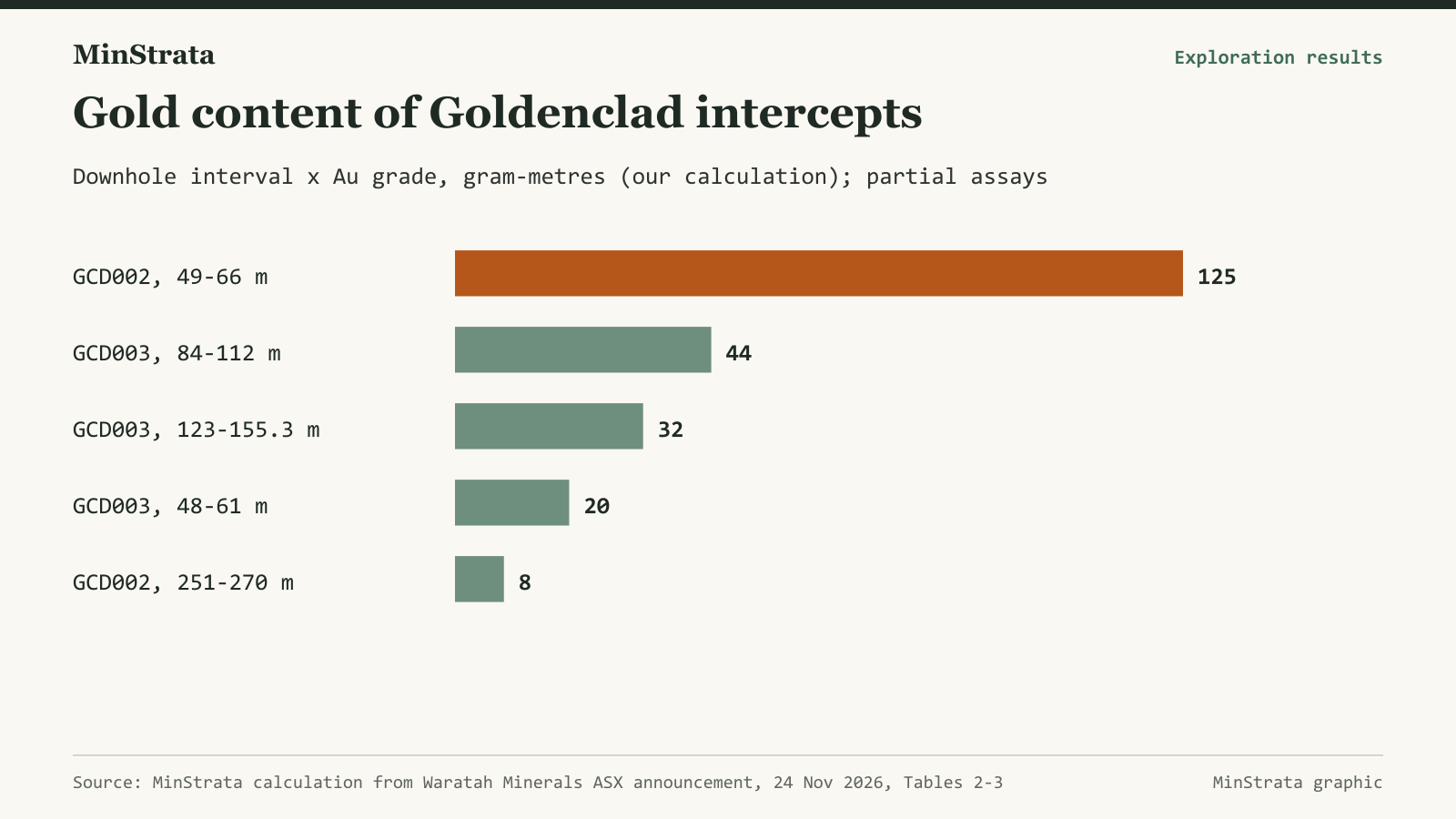
Interval multiplied by grade gives gram-metres, a rough measure of gold in a hole. On our calculation, the GCD002 zone from 49 m carries about 125 gram-metres (17 x 7.35), against 44 for GCD003's zone from 84 m and 32 for its zone from 123 m.[1]
The 10 m headline interval holds about 122 gram-metres. Two single metres, 40.20 g/t from 57 m and 18.61 g/t from 54 m, contribute about 59 of those, or 48% (our calculation). Without them, the other eight metres average about 7.9 g/t.[1]
The company applied no top cut, a cap that limits how much a few very high assays affect an average. It used photon assay, which tests a 500 g sample instead of the 50 g of a fire assay. The company says this can measure coarse gold more reliably.[1]
At Spur and Consols, the company estimates true widths at more than 80% of downhole lengths. It makes no such estimate for Goldenclad.[1]
What the results don't show
- Continuity: GCD002 is a single hole on the Wollard's Line, and GCD003 is one hole across the Goldenclad Line. Neither shows how far the lodes extend.
- Geometry: the company says the broad geometry is subvertical but that more drilling is needed. True widths are unknown.
- Metallurgy: the recovery tests the company cites (above 90% at Spur and above 89% at Consols) were not done on Goldenclad material.
- Economics: Goldenclad has no resource or study. The company's view that it belongs to the same gold system as Spur and Consols is an exploration thesis.
Tenure: an option, not ownership
Goldenclad is on mining and gold leases ML960, ML1092 and GL3694. Their sole owner is M.N.I. Mining Pty Ltd. On 2 June 2026 Waratah secured an exclusive option to buy all of that company's shares. The announcement does not say whether the option has been exercised.[1]
The existing Spur resource, by category
| Category | Tonnes (Mt) | Au (g/t) | Contained Au (koz) |
|---|---|---|---|
| Indicated | 21.6 | 1.18 | 820 |
| Inferred | 61.3 | 1.1 | 2,260 |
| Total | 82.9 | 1.2 | 3,080 |
Open-pit portion at a 0.5 g/t Au cut-off; underground portion at a 1.0 g/t Au cut-off. Figures may not sum due to rounding. On our calculation, about 73% of the contained gold is in the Inferred category. Full details were released on 4 November 2026. Source: Waratah Minerals ASX announcement, 19 November 2026, Annexure A.
Reporting basis
The results are reported under the JORC Code (2012). The Competent Person is Mathew Brown, a member of the Australian Institute of Geoscientists and a full-time employee of Waratah Minerals.[1]
“While drilling at Goldenclad remains at an early stage, Waratah's geological team is systematically defining the controls, continuity and architecture of the mineralised system.”
Stewart said this in the announcement. He added that GCD003 had intersected three significant gold zones within the top 155 metres.[1]
What comes next
GCD002 was at 628 m and is planned to pass 700 m to test the Ironclad line. GCD003 was at 704 m and is planned to reach at least 800 m. The company expects final assays about three weeks after each hole is completed.[1]
Waratah announced a A$50 million placement on 19 November 2026. It said the funds will support a drilling campaign of more than 100,000 m over 12 months, with a Spur resource update targeted for the third quarter of 2027.[2]