NexGen (ASX: NXG) stretches its PCE high-grade zone to 739 m deep, on gamma readings not yet backed by assays
Fifteen new holes near the Arrow uranium deposit in Saskatchewan extend the zone deeper and along strike. Lab assays from the 2026 program are still to come.
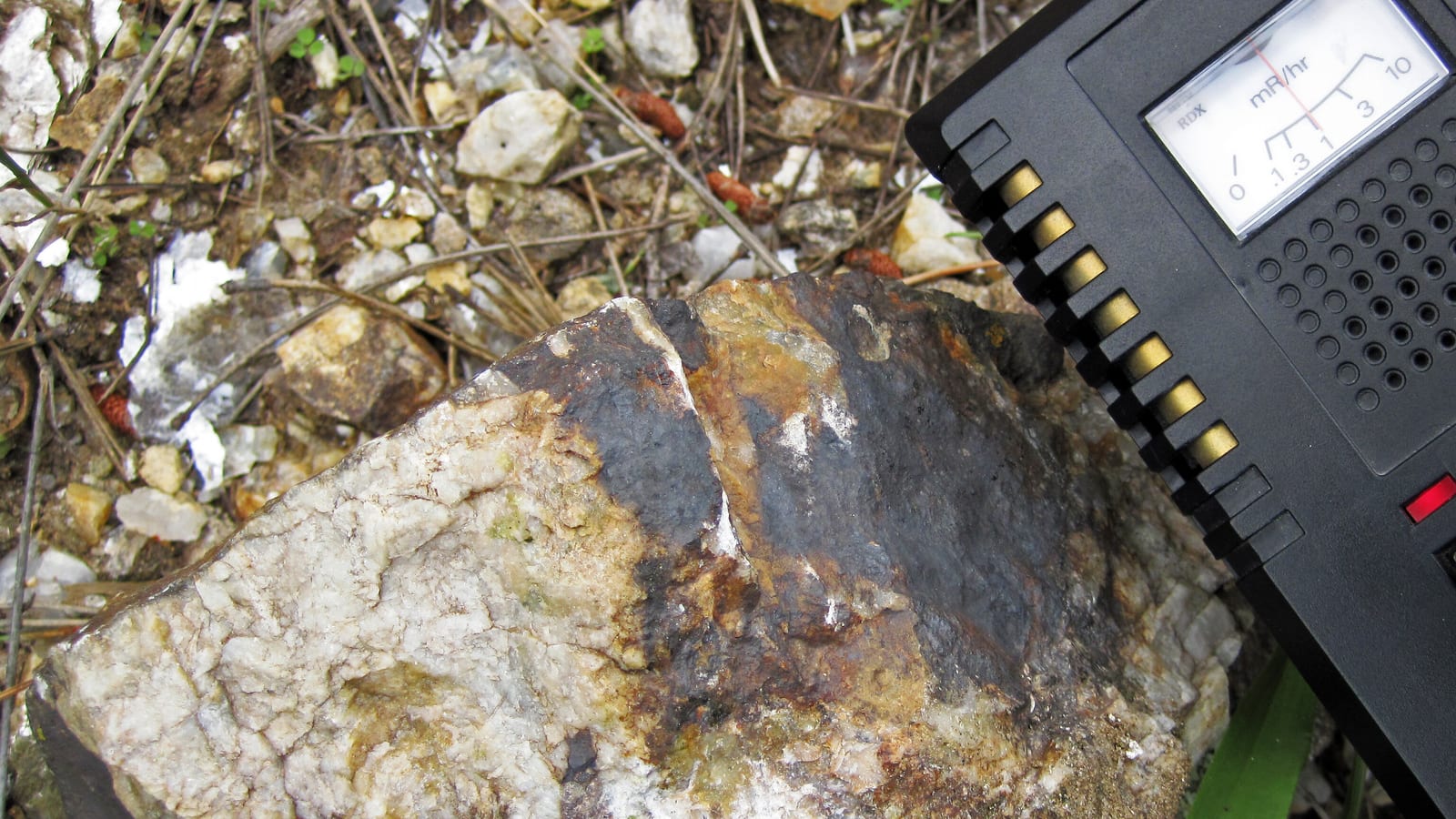
NexGen Energy (TSX, NYSE: NXE; ASX: NXG) has reported 15 more drill holes from Patterson Corridor East, a uranium discovery 3.5 km from its Arrow deposit in Saskatchewan's Athabasca Basin. The company said the results, released on 24 November in Canada and lodged on the ASX on 25 November, expand the high-grade part of the system and confirm its internal continuity.[1]
The numbers in this release are radioactivity readings taken on drill core with a handheld instrument, not laboratory measurements of how much uranium the rock contains. That distinction decides how much weight the results can carry today.[1]
What the gamma readings measure
NexGen measures natural gamma radiation in counts per second (cps) with an RS-125 spectrometer. It labels readings above 500 cps anomalous, above 10,000 cps high grade, and above 61,000 cps off-scale. Its technical disclosure attaches a warning:[1]
“The reader is cautioned that total count gamma readings may not be directly or uniformly related to uranium grades of the rock sample measured”
The company adds that the readings should be treated only as a preliminary sign that radioactive minerals are present.[1]
Grades in percent U3O8 come later, when the independent Saskatchewan Research Council Geoanalytical Laboratory assays the core. NexGen says samples are submitted continuously and results will follow in batches.[1]
The reported extensions
| Hole | Result | What NexGen says it shows |
|---|---|---|
| RK-26-293c1 | Cumulative 2.5 m > 10,000 cps | High-grade subdomain extends 95 m deeper, to 739 m vertical extent |
| RK-26-297c3 | Cumulative 9.5 m > 10,000 cps, incl. 0.1 m > 61,000 cps | Strike extension to the southwest |
| RK-26-301 | Cumulative 1.7 m > 10,000 cps, incl. 0.2 m > 61,000 cps | Strike extension to the northeast |
| RK-26-300 | Cumulative 10.0 m > 10,000 cps, incl. 1.8 m > 61,000 cps | Continuity between earlier high-grade holes |
| RK-26-299c1 | Cumulative 4.2 m > 10,000 cps, incl. 0.7 m > 61,000 cps | Continuity in the southwest |
| RK-26-297c1 | Cumulative 6.0 m > 10,000 cps, incl. 0.7 m > 61,000 cps | Possible extension at depth on a steep shear |
All depths and intervals are downhole; NexGen says true thicknesses are yet to be determined and require resource modelling. 'Cumulative' sums separate intervals within a hole. cps = counts per second on an RS-125 gamma spectrometer, not uranium grade. Source: NexGen Energy release, 24 November 2026, highlights and Table 1.
The assayed comparison points are earlier holes. RK-26-300 sits 25.0 m from RK-24-207, which assayed 9.5 m at 2.9% U3O8, and 29.0 m from RK-25-230, which assayed 7.5 m at 5.3% U3O8. Those grades belong to the earlier holes and do not tell us the grade of RK-26-300.[1]
How fast the footprint has grown
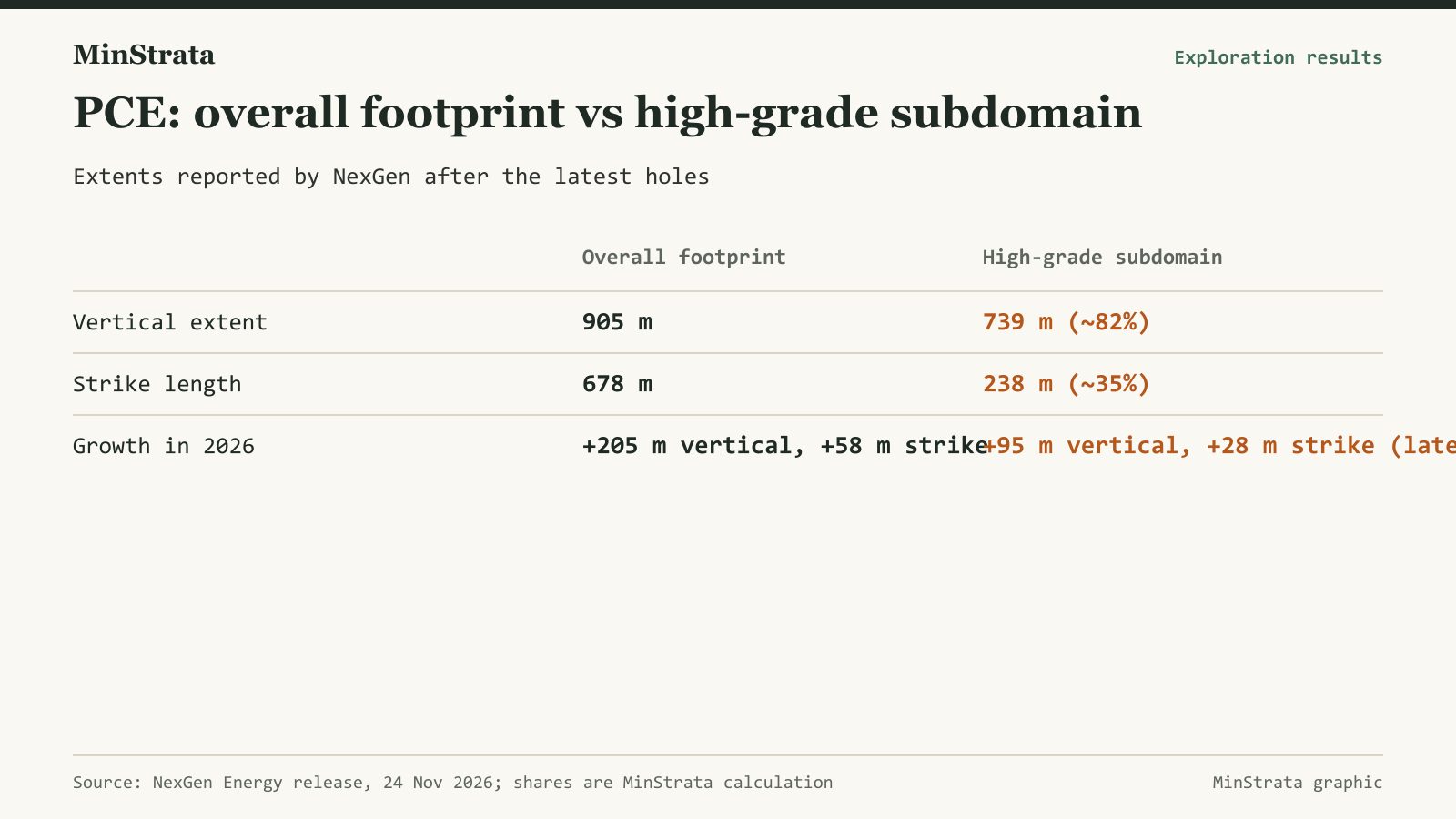
Across 2026, NexGen says the overall mineralised footprint at PCE has grown vertically by 205 m to 905 m and along strike by 58 m to 678 m. The high-grade subdomain within it is smaller: 739 m vertically and 238 m along strike.[1]
On our arithmetic, the high-grade subdomain spans about 82% of the footprint's vertical extent but about 35% of its strike length, so the intense mineralisation is concentrated in a relatively narrow band along the shear. That is a reading of the company's dimensions, not a resource estimate.[1]
“The high-grade at PCE continues to grow and show strong continuity which are both characteristics of the Arrow Deposit during its development.”
Reporting basis
NexGen reports under Canada's National Instrument 43-101, not the JORC Code, so there is no JORC Competent Person statement. The release says Jason Craven, the company's head of exploration (Vice President, Exploration), signed off its technical content as a qualified person under NI 43-101, the Canadian counterpart to a Competent Person. PCE has no Mineral Resource estimate.[1]
What comes next
The rest of the 42,000 m program will target internal high-grade continuity and further expansion. The first laboratory assays from the 2026 holes will be the first test of how the gamma readings translate into grade.[1]
Questions readers ask
- Are 10,000 cps and 61,000 cps uranium grades?
- No. They are radioactivity readings from a handheld spectrometer. NexGen cautions they may not relate directly or uniformly to grade; laboratory assays are needed.[1]
- Is PCE part of the Rook I mine plan?
- The release describes PCE as a separate discovery 3.5 km from the Arrow deposit, with no resource estimate yet.[1]