Amara Minerals reports 45.8 m at 5.88 g/t gold down dip at Apollo in Victoria, about 21.5 m true width
The interval is averaged with no lower cut-off, and six short zones carry about two-thirds of its gold. Apollo has no resource yet; one hole is still drilling.
Amara Minerals (ASX: AM3) has reported 45.8 m at 5.88 g/t gold from 242.2 m in diamond hole AA2604 at its Apollo Gold and Antimony Project in central Victoria. The company released the fire assays to the ASX on 24 November 2026 and called it its best result at Apollo by grade times width.[1]
AA2604 was drilled to test the Dig Fault Zone below three earlier holes, AA2601 to AA2603. The company says it is now the deepest intercept in the southern extension of the mineralisation, which remains open at depth and to the south of the historic Meade's Open Cut.[1]
The reported intercept and its high-grade zones
| Interval | From (m) | Length (m) | Au (g/t) |
|---|---|---|---|
| Main zone | 242.2 | 45.8 | 5.88 |
| incl. | 252.5 | 9.0 | 12.3 |
| incl. | 254.6 | 0.8 | 54.2 |
| incl. | 256.2 | 0.8 | 22.9 |
| incl. | 258.6 | 1.4 | 14.3 |
| incl. | 275.9 | 0.6 | 66.2 |
| incl. | 284.9 | 3.1 | 17.7 |
| incl. | 287.5 | 0.5 | 49.2 |
| Separate structure | 292.0 | 1.8 | 3.9 |
Length-weighted averages of downhole widths with no lower cut-off and no top cut; values below 0.01 g/t treated as 0.005 g/t; unrecovered core assigned zero. Estimated true width of the main zone about 21.5 m (approximate, from the interpreted orientation of the Dig Fault Zone). Fire assay at OnSite Laboratories, Bendigo. Assays for the lower part of the hole pending. Source: Amara Minerals ASX announcement, 24 November 2026.
Why the averaging method matters
Most explorers report intercepts above a stated cut-off grade, so weak material at the edges drops out. Amara instead averaged the whole zone with no lower cut-off. That tends to give a longer interval at a lower average, and the company also states that no top cut was applied to the very high individual assays.[1]
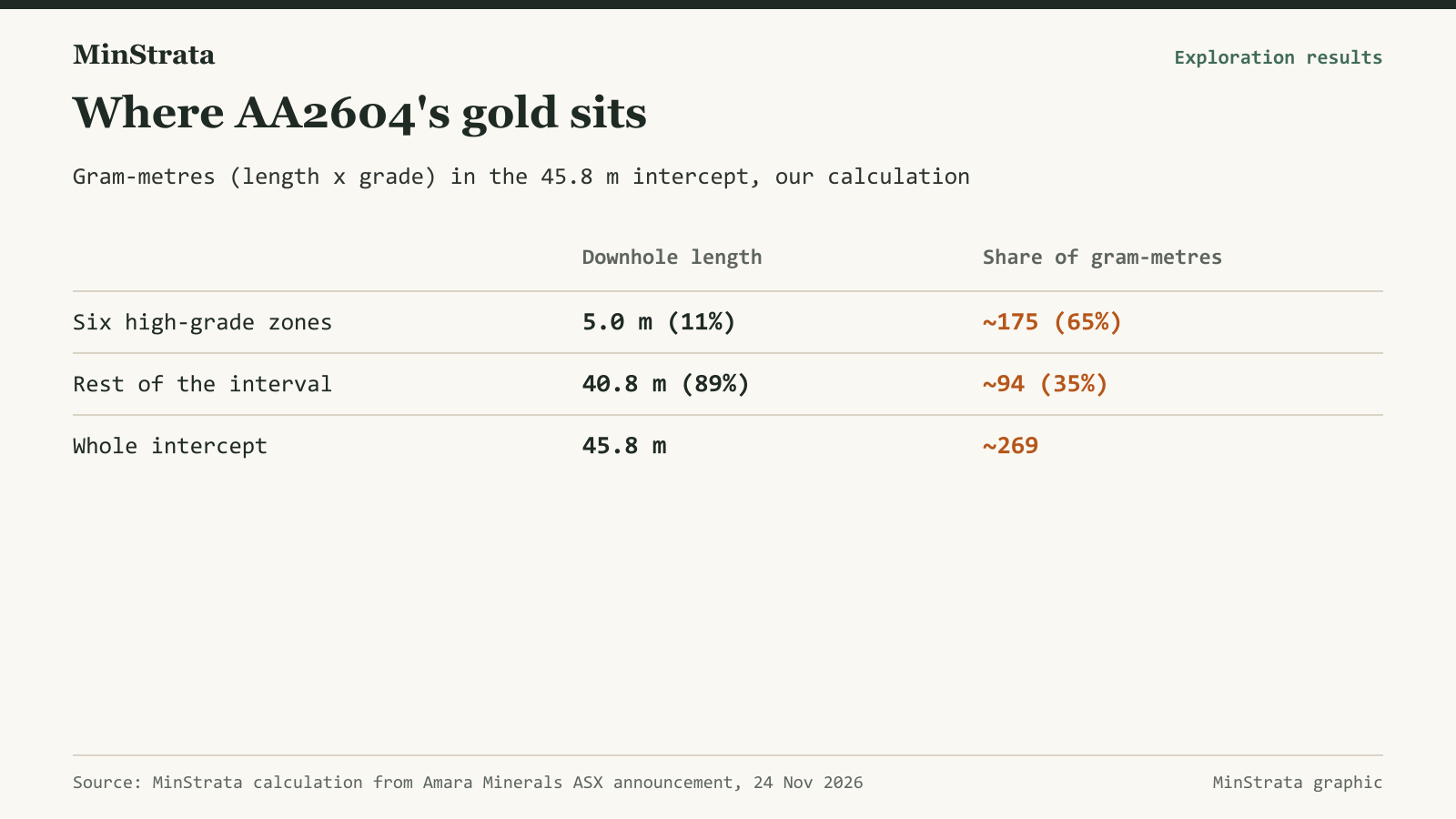
The gold is unevenly spread. Six listed sub-intervals totalling 5 m carry about 175 of the intercept's roughly 269 gram-metres, or 65%. The remaining 40.8 m average about 2.3 g/t. Those are our calculations from the company's figures.[1]
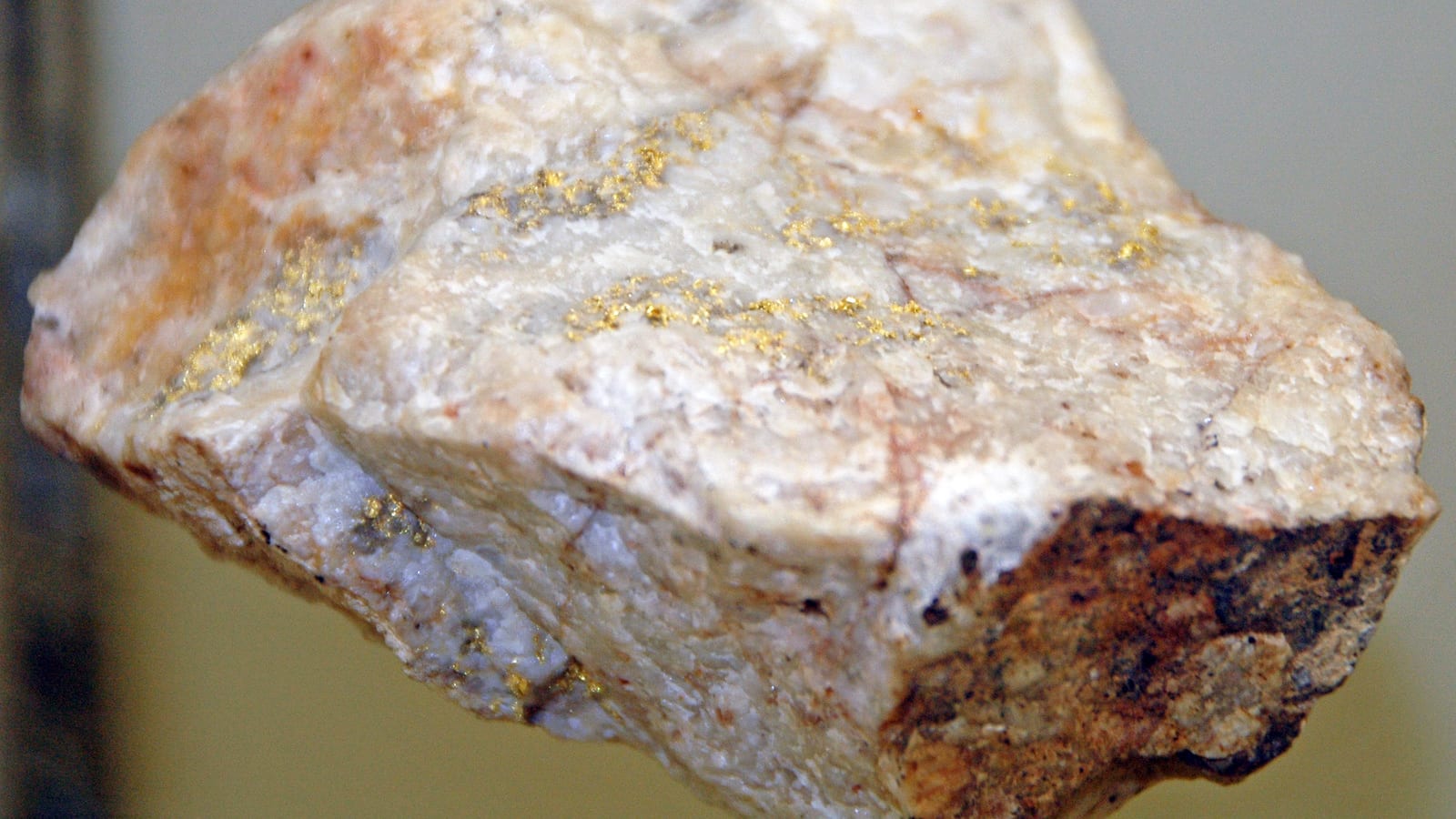
Two of those zones, 0.6 m at 66.2 g/t and 0.5 m at 49.2 g/t, match the fine visible gold the company logged in AA2604 and reported on 12 October. High-grade, nuggety gold of this kind is common in central Victoria and makes grades harder to predict between holes.[1]
“Almost 46 metres at close to 6 g/t gold, with two intervals above 50 g/t, tells us the Dig Fault Zone is carrying strong grade at depth, and it remains open.”
Context: what has been drilled before
Six diamond holes totalling 2,102.8 m have been completed at Apollo, and the seventh is underway. Historical holes by previous explorers, which Amara reported in February 2025, include 39.5 m at 7.25 g/t from 118.6 m in GMDH28 and 28.0 m at 10.2 g/t from 138.0 m in GMDH36.[1]
The company mentions the nearby Sunday Creek deposit and Costerfield mine, both in Victoria's Melbourne Zone, and states that they are geological context only and do not guarantee similar results at Apollo.[1]
What the result doesn't show
- Continuity of the high grades between holes; AA2604 is a single pierce point down dip of the earlier holes.
- The rest of the hole: assays for the lower part of AA2604, and for part of AA2605, are pending.
- A resource: Apollo has no Mineral Resource, and the company describes a maiden estimate only as something it is evaluating.
- Antimony grades: the project carries antimony in its name, but this announcement reports gold only.
Reporting basis
The exploration results are reported under the JORC Code (2012). The Competent Person is Ian Holland, a Fellow of the Australasian Institute of Mining and Metallurgy, who is also Amara's Managing Director, as the announcement states.[1]
What comes next
AA2606 has been drilled to just over 300 m and AA2607 is underway; both test for mineralisation near a granite contact at depth, which earlier explorers noted can host low-grade gold. Amara expects drilling to finish in early December, when AA2607 reaches target depth.[1]
Questions readers ask
- Is the gold zone 45.8 m thick?
- No. 45.8 m is the downhole length. Amara estimates the true width at about 21.5 m, based on its interpretation of the fault zone's orientation.[1]
- What does 'no lower cut-off' mean here?
- The company averaged every sample across the zone, including low-grade ones, rather than excluding material below a threshold grade. It also applied no cap to the highest assays.[1]