Lynas makes a record 2,082t of NdPr as Iluka and Arafura build Australia's next rare earths refineries
Australia has the ore. Its supply to buyers outside China now depends on separation capacity: one plant running, one 65% built and one just started.

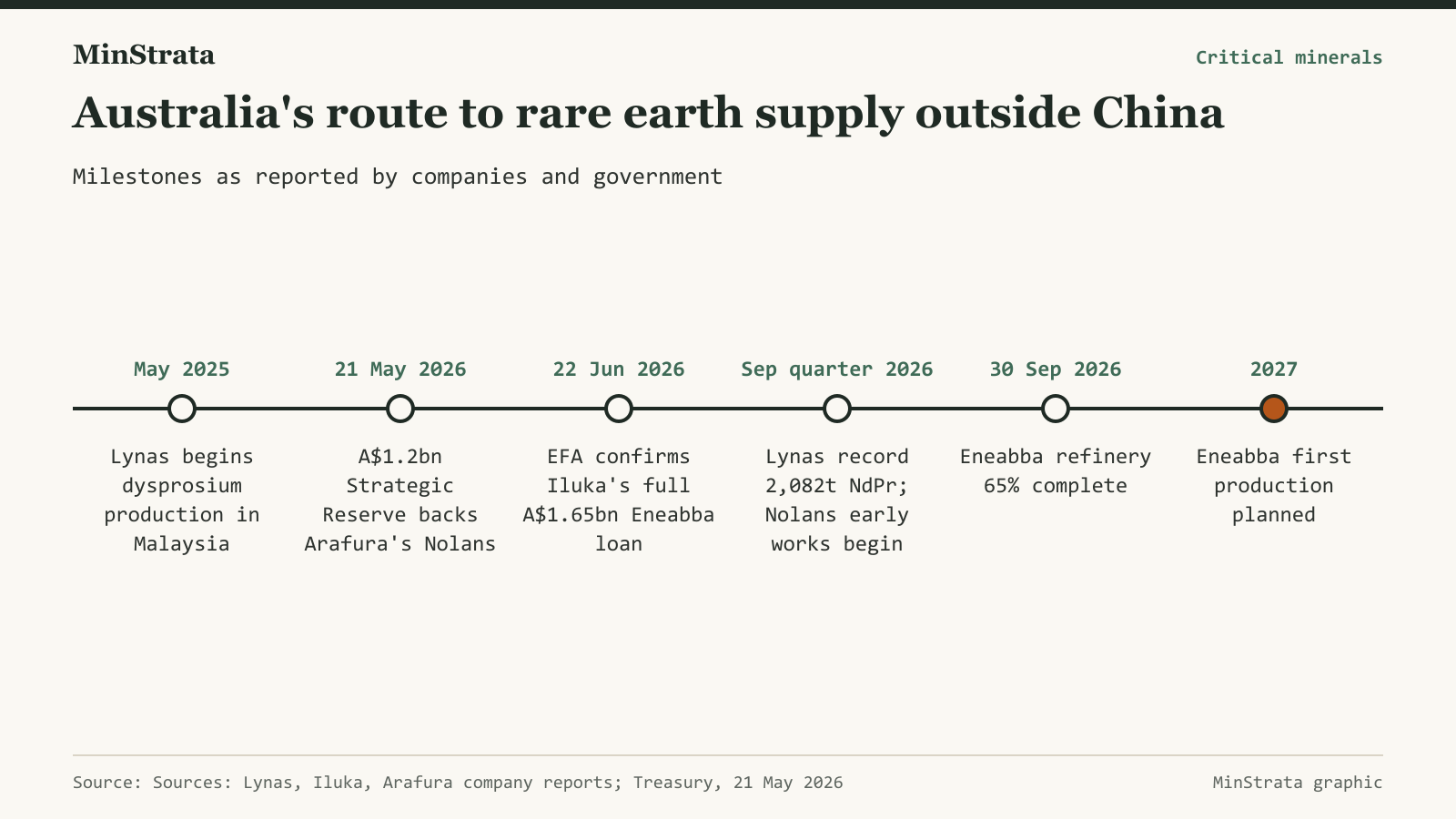
Lynas Rare Earths (ASX: LYC) produced 2,082 tonnes of neodymium-praseodymium (NdPr) oxide in the three months to 30 September, a quarterly record, its report of 29 October shows. NdPr is the main input for the permanent magnets used in electric motors and wind turbines. The company also made 23 tonnes of the heavy rare earths dysprosium and terbium.[1]
Lynas is still Australia's only operating separator. Two more Australian refineries are being built for buyers outside China. Iluka Resources (ASX: ILU) says its Eneabba refinery in Western Australia is 65% complete. Arafura Rare Earths (ASX: ARU) started early works at Nolans, north of Alice Springs, during the quarter. When these plants start producing, and how quickly they ramp up, will decide how much separated oxide Australia can sell outside China before 2030.[1][2][5]
The resource base supports that view. Geoscience Australia puts Australia's Economic Demonstrated Resources at 7.36 million tonnes of rare earth oxide (including yttrium oxide), third in the world with 8% of the total. In 2024 the country produced 0.031 million tonnes of oxide, also third with 8%.[7]
Three Australian routes, three stages
| Company and project | Stage | Output or capacity | Government support | Next milestone |
|---|---|---|---|---|
| Lynas: Mt Weld and Kalgoorlie (WA), separation in Kuantan, Malaysia | Operating | 2,082t NdPr and 23t Dy+Tb in the Sep 2026 quarter; Malaysian nameplate is 900t of NdPr a month | Not covered in its September quarterly report | About one month of planned maintenance shutdown in Malaysia in the December quarter |
| Iluka: Eneabba refinery (WA) | Construction, 65% complete | Design capacity of 5,500 tpa NdPr oxide and 750 tpa Dy+Tb oxide; illustrative NdPr output of about 3,700-3,900 tpa from Eneabba and Balranald feed | A$1.65bn non-recourse loan via the Critical Minerals Facility, administered by Export Finance Australia | Construction completion and first production in 2027, then a two-year ramp-up |
| Arafura: Nolans (NT) | Early construction works | Offtake agreements for 500 tpa and up to 850 tpa of NdPr | Strategic Reserve commitment for 500t; up to A$700m debt and about A$140m equity committed (Treasury) | Contractual close of project debt |
Company figures are as reported and have not been independently verified. Lynas's nameplate rate is not a production target. Iluka's output range is the company's illustrative scenario. Sources: Lynas quarterly report, 29 Oct 2026; Iluka quarterly review, 27 Oct 2026, and site visit presentation, 2 Nov 2026; Iluka ASX notice, 22 Jun 2026; Arafura quarterly report, 30 Oct 2026; Treasury media release, 21 May 2026.
Condition 1: the operating plant has to run steadily
Lynas's quarterly NdPr output has moved between 1,404 and 2,082 tonnes over the past five quarters. The company said concentrate quality problems that began in the June quarter hurt production again in July, before output recovered in August and September.[1]
Data table
| Item | tonnes |
|---|---|
| Sep Q 2025 | 2,003 |
| Dec Q 2025 | 1,404 |
| Mar Q 2026 | 1,996 |
| Jun Q 2026 | 1,857 |
| Sep Q 2026 | 2,082 |
Lynas financial-year quarters Q1 FY26 to Q1 FY27. Source: Lynas Rare Earths, Quarterly Report for the period ended 30 September 2026, published 29 October 2026.
The December quarter will be lower. Lynas has scheduled a shutdown of about one month in Malaysia for statutory electrical work and kiln maintenance. Its Kalgoorlie plant also faces a shutdown of about two weeks while Western Power modifies its network.[1]
Heavy rare earths are the scarcer product. Lynas has made dysprosium since May 2025, terbium since June 2025 and samarium since March 2026. It says its expanded heavy rare earths plant will produce gadolinium first and then yttrium.[1]
Condition 2: the new refineries have to start and ramp up
Iluka's refinery is the nearest to production. In June the company said Export Finance Australia had confirmed its access to the full A$1.65 billion non-recourse government loan. It expected the A$1.25 billion first tranche to be fully drawn by the end of 2026.[4]
Iluka's 2 November site presentation shows construction finishing and first production in 2027, followed by a two-year ramp-up. It says initial output is planned below circuit capacity. Iluka also estimates that if magnet capacity outside China grows by about 80,000 tonnes a year, about 30,000 tonnes a year of extra NdPr oxide would be needed, and Eneabba would supply about 4,000 tonnes of it.[3]
Nolans is earlier in its development. Arafura began early site works and mobilisation in the September quarter, and its lenders were still working through final credit approvals. Managing director Darryl Cuzzubbo described the investment decision as a starting point.[5]
“FID was not the finish line, it was the start and we know the task ahead is significant”
Condition 3: buyers have to pay for supply from outside China
Pricing outside China is being set partly by contract terms rather than by the market index. Lynas said its average selling price was a record A$102.1 a kilogram. Floor-price agreements now cover more than half of its production. The company linked demand to continuing uncertainty over future export controls.[1]
Iluka's illustrative economics assume an NdPr price of US$110 a kilogram. The company references this to the floor price agreed between MP Materials and the US Department of Defense. If buyers stop accepting floor prices like these, the projects' revenue assumptions would weaken.[3]
Condition 4: government support has to reach financial close
Canberra's support takes different forms for each project: a loan for Iluka, and debt, equity and an offtake commitment for Arafura. The Treasurer, the Trade Minister and the Resources Minister announced the Strategic Reserve's backing for Nolans on 21 May.[4][6]
“Australia has exactly what the world needs, when the world needs it,”
Arafura also has equity subscriptions of US$100 million (about A$146 million) from Export Finance Australia and about A$84 million from Germany's Raw Materials Fund. Both are expected to complete alongside the debt facilities.[5]
Questions readers ask
- What is NdPr?
- NdPr is a mixed oxide of neodymium and praseodymium. It is the main rare earth input for NdFeB permanent magnets. Iluka's presentation assumes about 30 tonnes of NdPr metal for every 100 tonnes of magnets.[3]
- Why does separation hold up supply more than mining?
- Mined concentrate has to be chemically cracked and then separated into individual oxides through many solvent extraction stages. At Eneabba this involves a sulfuric acid roasting kiln and several separation circuits. Iluka's capital estimate for the refinery is A$1.7-1.8 billion.[2][3]
The next markers are Lynas's annual meeting on 25 November and its December-quarter output after the Malaysian shutdown. After that come full drawdown of Iluka's first loan tranche by the end of 2026, contractual close of Arafura's debt, and Eneabba's first production in 2027.[1][4][5][3]